Reviews
Part of Social media strategy explained for business teams
9 social media strategy checks before signing off
Nine social media strategy checks for Canadian accounts, covering outcomes, audience evidence, account roles, governance, platform fit and review.
What to take away
- A sign-off checklist tests decisions, not the existence of accounts.
- Every check needs a named owner and a record someone can read later.
- Social media's job beside email, search and paid media gets written down.
- Each account needs one job and a closure plan for the ones that lost it.
- The review ends in continue, revise, stop or test, with a date.
A social media strategy sign-off is a decision meeting, not a filing exercise. Work through the nine checks below before launch and at each quarterly review.
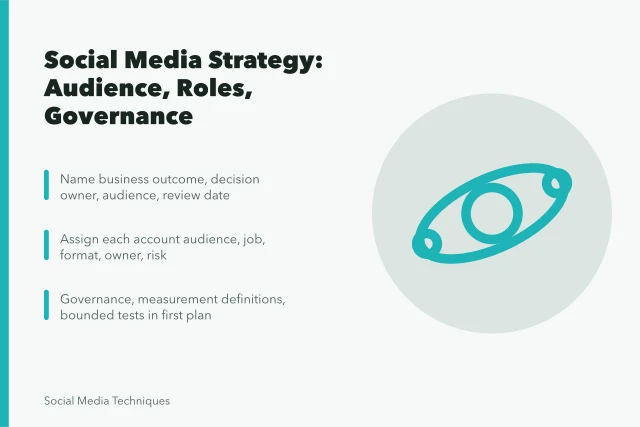
1. Business outcome and decision owner
Write the outcome as a change in the business, not in the feed. "Forty booked consultations a month from Instagram" is an outcome. "Grow engagement" is a mood.
Name one person who can stop the work. If two people share that authority, the strategy stalls at the first disagreement.
2. Audience evidence
Assumptions about the audience are cheap. Evidence is not: past buyer lists, support tickets, search terms, or a short set of interviews.
For Canadian accounts, note where the audience sits. Quebec buyers see French-language advertising requirements under Bill 96, and a qualified lawyer confirms how far they reach your material.
3. Social media's role beside other channels
State what social does that email, search and paid media cannot. Lead generation, retention, hiring and support are four different jobs, and a single account rarely does all four well.
If social is the only channel carrying a message, say so. That is a risk, not a plan.
4. Stop condition
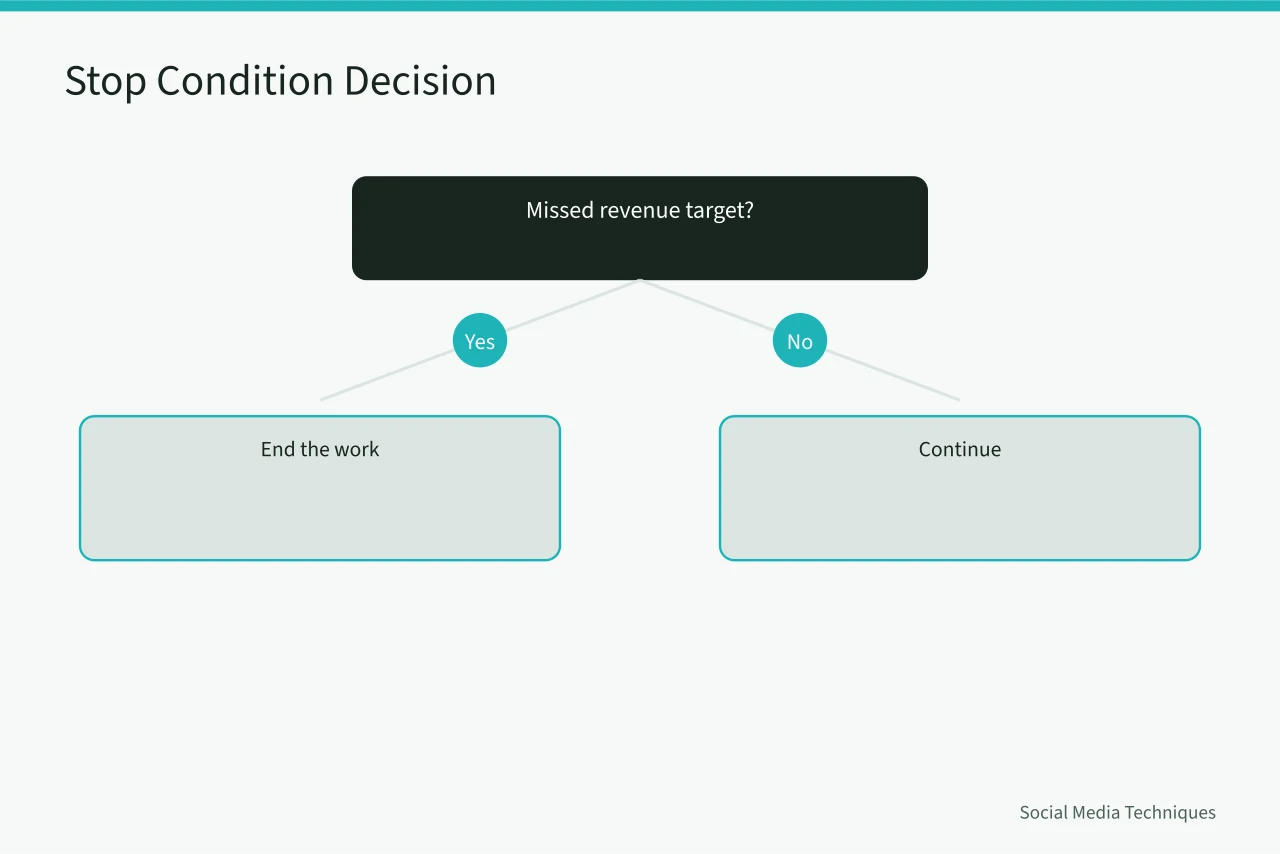
Decide in advance what would end the work. A missed revenue target, a platform change, a staff departure, or a cost per acquisition above the figure you can carry.
Write the number as your own variable: monthly spend divided by booked jobs gives cost per booking. Compare it with what a booking is worth to you.
5. Account job and closure
Give each account one job and one owner. A dormant account still carries your brand, still collects messages, and still appears in search.
Record who closes an account and where the archive goes. Provincial public-sector bodies in Ottawa, Winnipeg, Halifax and Montreal keep their own retention policies; a private business should still decide its own.
6. Content pillars
Pillars connect what the audience needs to what the business knows. Three to five is workable. Twelve is a wish list.
Separate evergreen, timely and campaign work into three paths. A seasonal campaign misread in March costs the same production budget as one planned in September.
7. Benchmark comparisons
Compare like with like: same format, same audience, same season. A Reel from a boosted post does not belong in the same row as an organic one.
Separate organic, boosted and paid results in every export. If a metric definition is unclear, check the platform's own documentation rather than a blog summary.
8. Privacy review inside strategy
The W3C Privacy Principles set out shared privacy concepts for web systems and warn against pushing privacy work onto individuals. Apply that inside social media strategy development, where consent, retention and measurement rules get fixed.
Under PIPEDA, consent and purpose rules apply to personal data you collect through forms, contests and DMs. Name the regulator and take advice from a qualified Canadian lawyer; this page does not give it.
The CISA software acquisition fact sheet covers supply-chain exposure and vulnerability management. Those questions belong in a tool review, not in a marketing approval.
9. Accessibility and endorsement checks
The W3C Images Tutorial explains that alt text depends on purpose: informative images carry the point, decorative ones take a null alternative, functional ones describe the action.
The FTC's Endorsement Guides Q&A covers honest endorsements and material connections. Canadian practice adds Competition Bureau guidance and, for gifted product, CRA treatment that your accountant confirms.
Worked example: a ninety-day review
A Winnipeg retailer ran three accounts and one calendar. At the review, the team found the second account had posted twice in ninety days and the third had no owner.
| Check | What the owner confirmed | Record kept |
|---|---|---|
| Outcome | Booked consultations, not likes | Strategy note |
| Audience | Buyer list plus ten interviews | Evidence file |
| Account job | One account, one job | Closure plan |
| Benchmark | Organic and boosted split | Export with dates |
| Decision | Stop the dormant account, test Reels | Dated decision log |
The decision was stop, not revise. Content planning then rebuilt the calendar around one account.
Common questions
When should this checklist be used?
Before a launch, at each quarterly review, and after any material change to platform, team, budget or risk. A strategy that has not been reviewed in ninety days is a guess about last quarter.
Who owns the checks?
One accountable strategy owner coordinates the review. Legal, accessibility, privacy, community and analytics owners confirm their own areas and sign the record.
Does every account need the same checks?
Shared checks stay the same. Format, permission, audience, metric, moderation and escalation rules get added per account. Common social media strategy questions covers the recurring ones.