Rules
Part of Social media content planning: a practical guide
Flow versus output volume: the real content planning benchmarks that matter
Social media content planning benchmarks for 2027 covering capacity, cycle time, approvals, revisions, accessibility, response coverage, reuse, and outcomes.
What to take away
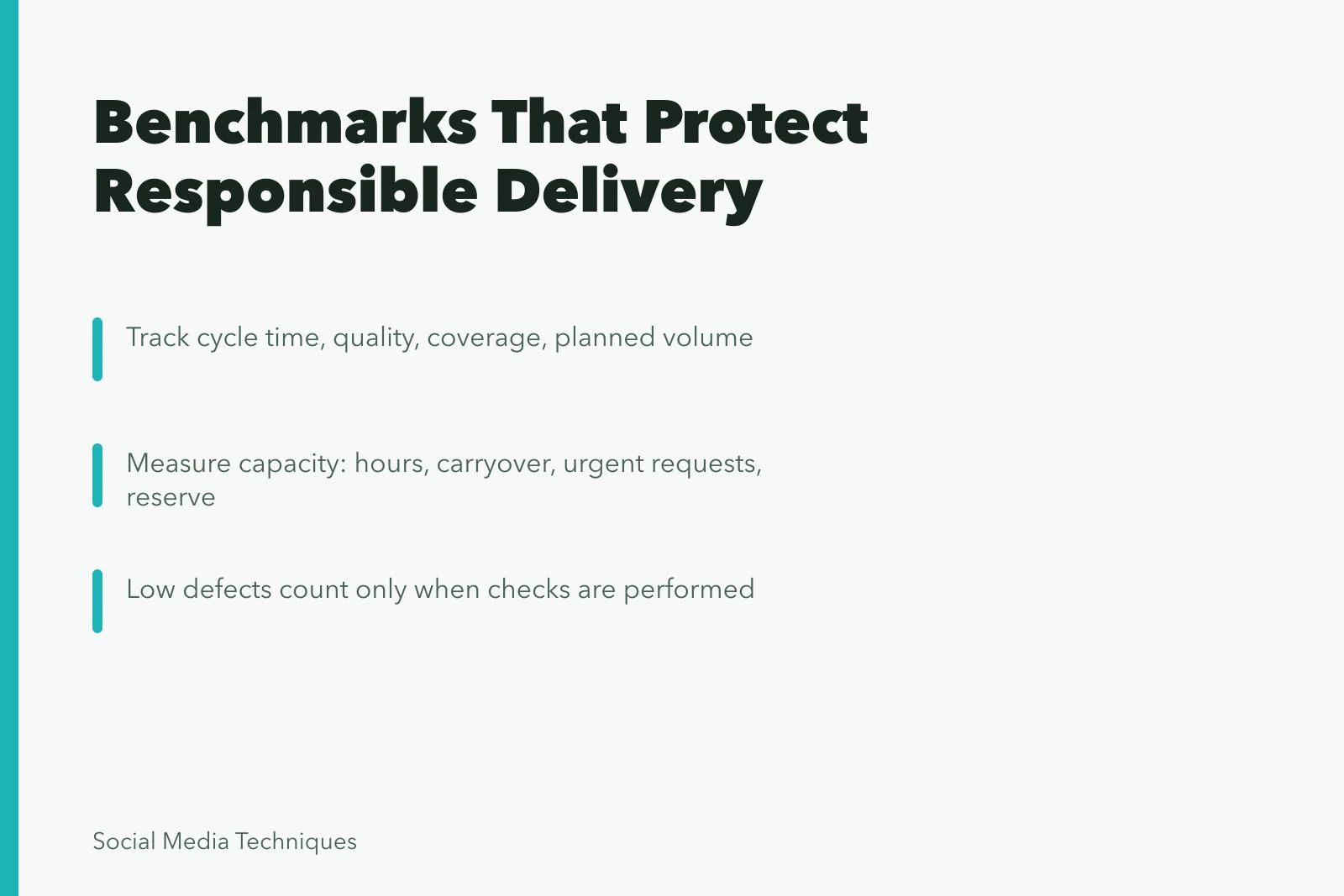
- Planning benchmarks should protect responsible delivery, not reward volume at any cost.
- Use comparable first-party history and explain every metric, range, sample, and assumption.
- Separate inputs and outputs from audience response, behavior, and business impact.
Social media content planning benchmarks should measure whether the team can deliver responsible work, not pressure it to publish a universal number of posts. Build a baseline from the team's own process, segment comparable work, and connect planning measures to audience and business decisions.
Benchmark the service and the communication
Federal service-contract guidance in FAR Part 37 describes measurable performance standards in terms such as quality, timeliness, and quantity, plus a method for assessment. A content team can adapt that principle to cycle time, quality, coverage, and planned volume without treating every item as equal.
The Government Communication Service's guide to evaluating low- and no-cost communications recommends an evaluation depth proportionate to resources and planning measurement from the start. It also distinguishes monitoring and reporting levels rather than demanding one oversized dashboard.
Capacity benchmarks
Track available production hours, planned items, work accepted, carryover, urgent requests, and unused reserve. Segment by format and risk. A customer video and an approved text update should not receive the same effort estimate.
Flow benchmarks
- Time from accepted request to approved brief
- Production and review cycle time
- Percentage approved by the planned date
- Number and cause of revision rounds
- Items delayed by missing assets or decisions
- Time from approval to scheduled publication
Quality benchmarks
- Claims with current source records
- Assets with documented rights
- Items completing accessibility checks
- Corrections, removals, and broken destinations
- Publishing or tracking defects
- Creator disclosure defects
A low defect count is meaningful only when checks are actually performed. Sample completed records and define severity. One unsupported regulated claim may matter more than several minor formatting errors.
Coverage and reuse benchmarks
Measure whether comments and messages had suitable coverage, escalations reached the right owner, and urgent cases met the response rule. For reuse, track source assets adapted, production time saved, permissions rechecked, and whether each version served a distinct platform role.
Audience and business evidence
Use native analytics after the planned window and preserve platform, report, filter, date, format, and distribution type. Compare planning changes with relevant audience action, but do not assume a faster cycle caused every performance change.
Set a realistic target
Use a range from comparable prior work, state assumptions, and review after a team, workflow, platform, format, or risk change.
Avoid external benchmark reports unless sample, metric definition, production context fit; a useful target improves a decision without encouraging hidden overtime or skipped review. Teams can start with realistic strategy benchmarks for a first-party baseline built from their history.
Review benchmarks with the people doing the work. A missed target may reflect an unrealistic estimate, a late dependency, a new risk, or a genuine process defect. Record the cause before changing the quota. Do not reward on-time delivery when it was achieved by skipping approval, accessibility, source, or response requirements.
Quick comparison
Example
- Capacity
- Accepted work and protected reserve
- Flow
- Brief, production, and approval time
- Quality
- Rights, accessibility, correction rate
- Outcome
- Useful audience or business action
Condition
- Capacity
- Segment by format and risk
- Flow
- Record delayed dependencies
- Quality
- Sample whether checks occurred
- Outcome
- State attribution limits
Make the comparison reproducible
The GAO evaluation design guide connects evaluation questions with evidence needs and design choices. Apply that discipline to social media content planning benchmarks; federal evaluation guidance does not make a local marketing result causal or transferable.
The NIST experimental design selection guidance begins design choice with the objective and practical constraints. It supports separating social media content planning benchmarks reporting from controlled effect estimates, not turning observation into causation.
Common questions
What is a good social media content planning benchmark?
A good benchmark uses comparable internal history, a clear definition, a realistic range, stated assumptions, and a decision the team can act on.
Should post volume be a planning target?
It can be a capacity input, but it should not reward skipped sources, rights, accessibility, approval, or community coverage.
How often should benchmarks be updated?
Review them after a meaningful change in team, format, risk, platform, process, audience, or distribution and during regular retrospectives.