Strategy
Part of Social media strategy explained for business teams
Setting realistic strategy benchmarks starts with a first-party baseline
Social media strategy benchmarks for 2027 using first-party baselines, comparable metrics, content segments, business actions, ranges, and limits.
What to take away
- There is no universal posting frequency, engagement rate, or reach target for every account.
- Define the metric and use comparable first-party history before setting a planning range.
- A benchmark should support a decision while showing its sample, filters, assumptions, and limits.
Social media strategy benchmarks for 2027 should begin with the account's own first-party history. There is no universal posting frequency, reach target, or engagement rate that fits every platform, audience, content type, objective, account size, geography, and distribution method.
Read native metrics before setting targets
LinkedIn's documentation for Page content analytics defines measures for posts and explains available filters and time ranges. Teams should preserve the live definition used for an export because labels and available fields can change.
YouTube's guidance on channel health and benchmarks says there is no single most important metric or universal good benchmark and recommends comparing performance with the channel's own history. It also suggests wider time views to understand trends and seasonality.
Define the metric before the target
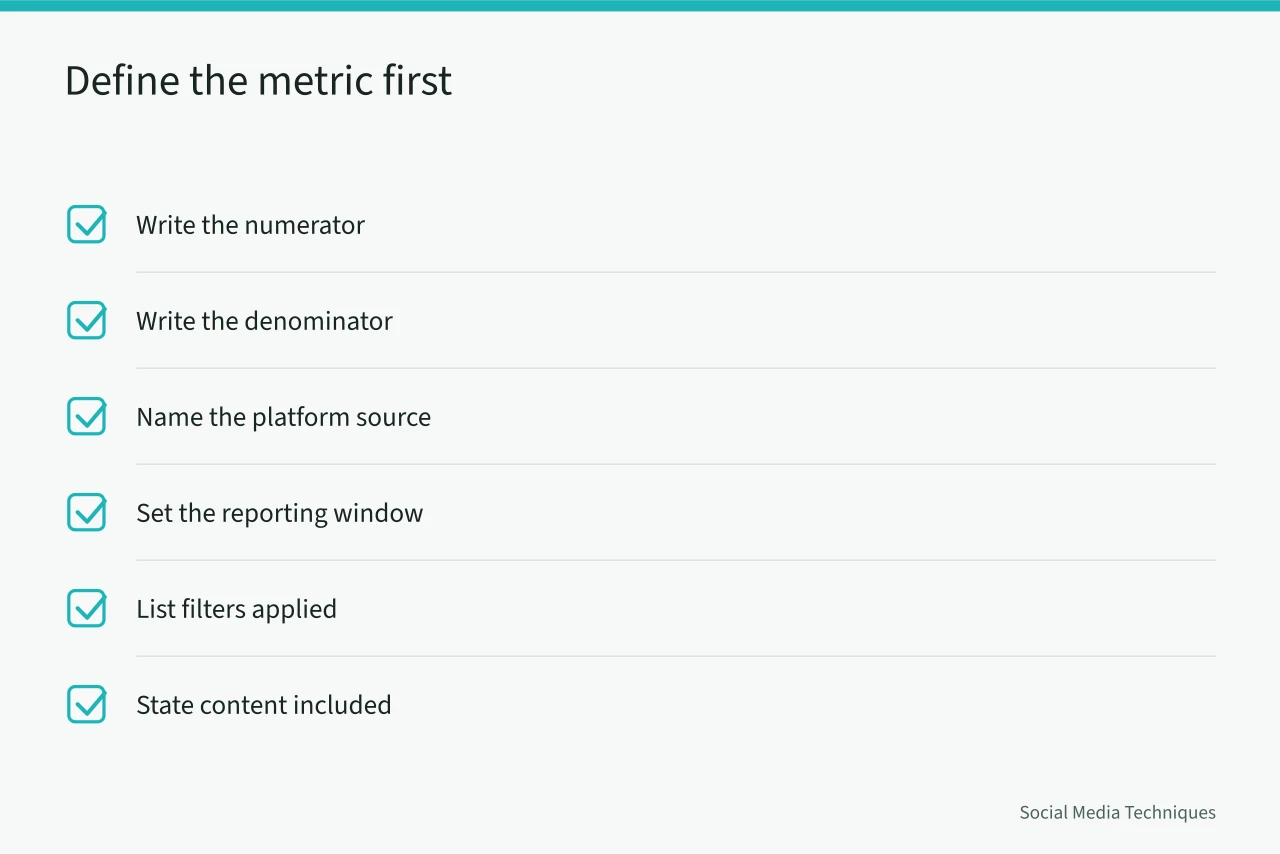
Write the numerator, denominator, platform source, reporting window, filters, and content included. A view, impression, click, reach figure, or engagement rate may be calculated differently across platforms, so a familiar label is not enough.
Build a first-party baseline
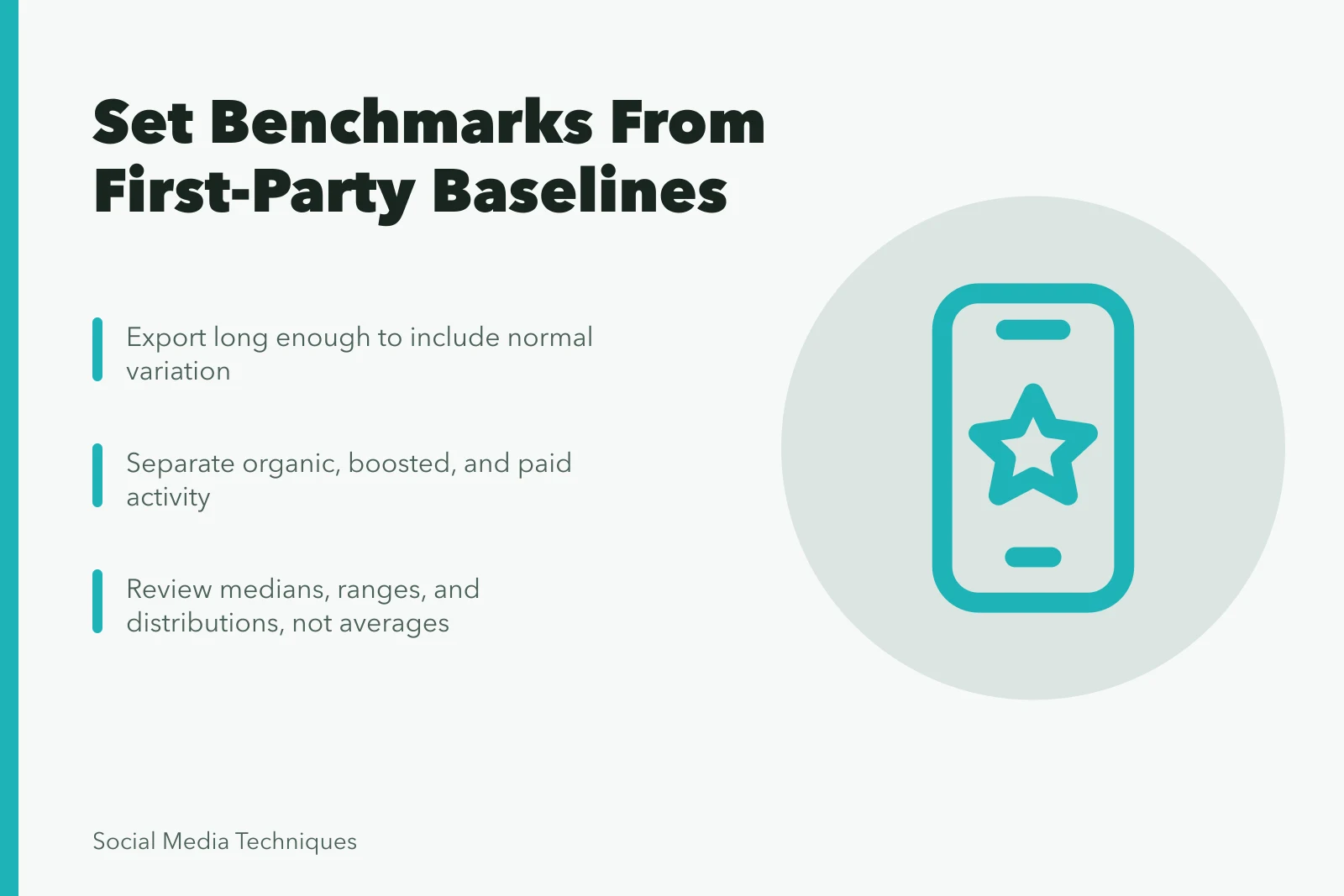
- Export a long enough period to include normal variation.
- Separate organic, boosted, and paid activity.
- Segment by platform, format, objective, audience, and campaign.
- Mark launches, outages, unusual events, and major spend changes.
- Review medians, ranges, and distributions, not only averages.
- Keep the raw export and the calculation method.
Connect benchmarks to the strategy
An awareness program might watch qualified reach, video starts, completion, branded search, or audience growth. An education program might examine watch time, saves, repeat viewers, resource clicks, and useful questions. Demand activity may use qualified visits, form completions, inquiries, or opportunity influence with a stated attribution method.
Use platform tools in context
Native analytics can separate content, reach, engagement, audience, and other report areas. A curated creative library can also help with research, but selected strong examples are not a typical-performance benchmark for every advertiser.
Set planning ranges
Use a conservative range based on comparable prior work, not a single exact promise, and add assumptions for production capacity, approval time, response coverage, and paid budget.
State what would make the range invalid, mark small-sample results as uncertain, and avoid turning ordinary variation into a trend. Review the target after a meaningful platform, audience, format, or campaign change. A social media strategy checklist keeps planning ranges tied to the assumptions behind them.
Handle external reports carefully
Inspect sample size, industries, account sizes, countries, dates, paid mix, calculation method, and sponsor. Check whether deleted posts, zero results, or unusually large accounts were excluded. If the sample does not match your situation, describe the result as directional. The most useful benchmark is one that supports a decision without hiding how it was created.
Quick comparison
| Benchmark input | Use it for | Do not claim |
|---|---|---|
| Own historical data | Comparable planning ranges | A guaranteed future result |
| Native metric definition | Consistent calculation | Cross-platform equivalence |
| External report | Directional context | Fit without sample review |
| Business action | Outcome relevance | Sole credit for social activity |
Make the comparison reproducible
The GAO evaluation design guide connects evaluation questions with evidence needs and design choices. Apply that discipline to social media strategy benchmarks; federal evaluation guidance does not make a local marketing result causal or transferable. The same discipline applies to common social media strategy questions, where goals and metrics must match before any benchmark is trusted.
The NIST experimental design selection guidance begins design choice with the objective and practical constraints. It supports separating social media strategy benchmarks reporting from controlled effect estimates, not turning observation into causation.
Common questions
What is a good social media engagement rate?
There is no universal answer. Define the formula and compare similar content, audiences, distribution, and periods within the same account.
How much history should a benchmark use?
Use enough comparable history to show normal variation and seasonality, while excluding or annotating events that make the period misleading.
Can industry reports set a target?
They can provide context after you inspect the sample, dates, geography, account sizes, paid mix, and calculation. Treat weak matches as directional.