Operations
Part of Social media content planning: a practical guide
What teams ask about social media content planning
Common social media content planning questions answered for 2027, covering calendars, frequency, briefs, capacity, rights, approvals, reuse, and measurement.
What to take away
- Planning horizons and posting pace depend on production complexity, risk, capacity, and support coverage.
- A shared calendar does not replace named owners for claims, assets, approval, publishing, response, and reporting.
- Reuse the source idea, then recheck accuracy, rights, accessibility, context, and platform fit.
Common social media content planning questions usually focus on calendars and posting frequency. The harder questions concern capacity, sources, rights, approvals, accessibility, community coverage, and measurement. A useful planning answer explains the conditions, the evidence, and the tradeoffs behind each choice.
Begin with user needs and publication choices
GOV.UK's guide to understanding content design starts with user needs and asks teams to choose the amount, format, and best place to publish, while avoiding duplication and keeping material current. Those questions come from the audience, the evidence, and the review path the team can support.
Its separate guide for identifying and recording user needs recommends evidence such as analytics, contact-center data, and research, plus acceptance criteria and an ownership record. A social planner can apply the same discipline to audience questions and proposed content.
How far ahead should teams plan?
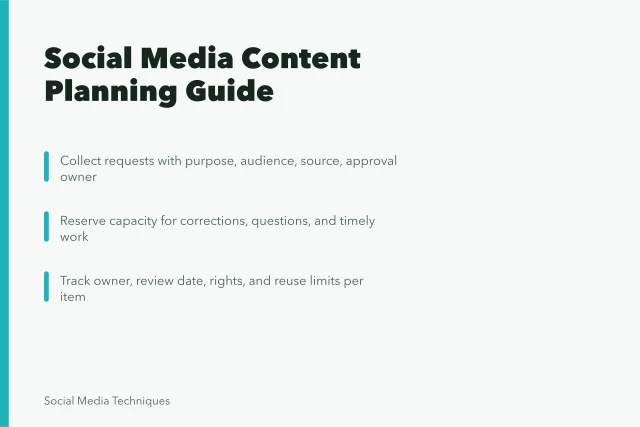
Plan stable campaigns and business events far enough ahead to secure assets and review. Keep some capacity open for customer questions, changes, and timely work.
A typical text update needs about two weeks of lead time. Video, translation, creator work, and regulated claims often need six to eight weeks. Treat those as typical ranges. The horizon depends on production complexity and approval risk.
How often should a business post?
Choose a pace the team can research, create, approve, publish, and support. A typical range is three to five posts a week per platform, but treat it as a starting point to test.
Test comparable periods and examine useful audience response alongside missed dates, revision load, and community coverage. More volume can reduce quality or leave comments unsupported.
What belongs in a content brief?
Include purpose, audience, message, source, format, action, destination, assets, rights, disclosure, accessibility, creator, reviewer, deadline, metric, and reuse limits. A brief should protect important boundaries without scripting away genuine expertise. A brief that lists rights and disclosure also needs a single record for every creator before outreach starts.
Field / Example entry
- Purpose
- Answer the five most common pre-sale questions
- Audience
- First-time buyers in the United States
- Message
- How the product fits an existing routine
- Format
- One text post and one short video
- Source
- Internal product notes, checked for accuracy
- Rights
- Owned images only, no paid use
- Owner
- Named writer and named reviewer
- Deadline
- Draft 10 days before publish
- Metric
- Saves and link clicks over 30 days
Who owns the calendar?
One planner should maintain status and dependencies, while named owners remain responsible for creation, claims, design, approval, publishing, response, and reporting. A shared calendar does not replace individual accountability.
How should creators be planned?
Agree on audience fit, factual claims, creative room, rights, review, payment, deadlines, safety, and disclosure. Make material brand relationships easy for the audience to recognize and verify current local requirements.
Can one asset be reused everywhere?
Reuse the source idea, but adapt the opening, format, length, action, captions, and context. Recheck claims and permissions. A video, quote, or customer story may have platform, region, paid-use, or expiration limits.
How is planning measured?
Track on-time approval, cycle time, revision rounds, defects, corrections, production cost, reuse, and response coverage. Add native platform results with their definitions, exports, filters, and reporting windows.
Set the planning horizon by working backward from the most complex dependency. Product launches, customer stories, creator work, video, translation, and regulated claims may need longer lead times than an approved text update. Mark tentative dates and maintain a fallback. Review the horizon after missed deadlines instead of assuming the requester will simply provide earlier notice next time.
Planning questions and what each answer depends on
| Planning question | Answer depends on | Record |
|---|---|---|
| How far ahead? | Dependencies and review risk | Milestones and fallback |
| How often? | Capacity and audience value | Comparable test periods |
| Who owns it? | Decision and workflow stage | Named role and status |
| Can it be reused? | Currency, rights, context, format | Review and use history |
Write the answer down as a decision record
The GAO evaluation design guide connects evaluation questions with evidence needs and design choices. Treat it as a model for evidence, not proof that a local marketing result is causal or transferable.
The W3C Privacy Principles statement gives web designers shared privacy concepts and warns against shifting privacy work to individuals. Review your governing law and configuration.
Record the chosen horizon, posting range, owners, and review date in one place.
Common questions
Does every business need a monthly content calendar?
No. Use the planning horizon and view that match the team's dependencies, volume, risk, and review cadence.
Who should approve social media content?
The approver depends on the claim, asset, product, legal, privacy, safety, brand, and accessibility risks involved.
Can a planner leave open space?
Yes. Reserved capacity allows the team to correct errors, answer customers, respond to real events, and absorb changed dependencies.