Reviews
Part of Social media strategy explained for business teams
7 points on choosing social media strategy tools
Social media strategy tools for 2027 compared by analytics, permissions, reporting, platform fit, data access, security, offboarding, and real cost.
What to take away
- Choose a tool for a named workflow and decision, not for the length of its feature list.
- Native systems are the first source for platform-specific permissions and reporting definitions.
- Test access, exports, security, total cost, and offboarding with representative work before committing.
Social media strategy tools should solve a defined workflow problem. Start with native platform tools for permissions, publishing, and first-party analytics. Add another product only when the team can name the missing capability, owner, and data. Also name the security review, cost, and expected decision improvement.
The seven points below cover workflow, native analytics, publishing, and listening. They also cover data access, security, and cost.
Compare two native workflow tools
YouTube's guide to Analytics Advanced Mode explains how to compare videos, groups, and periods. It also covers breakdown changes, filters, and exports of the current view. This makes it a focused reporting tool for YouTube rather than a cross-platform publishing system.
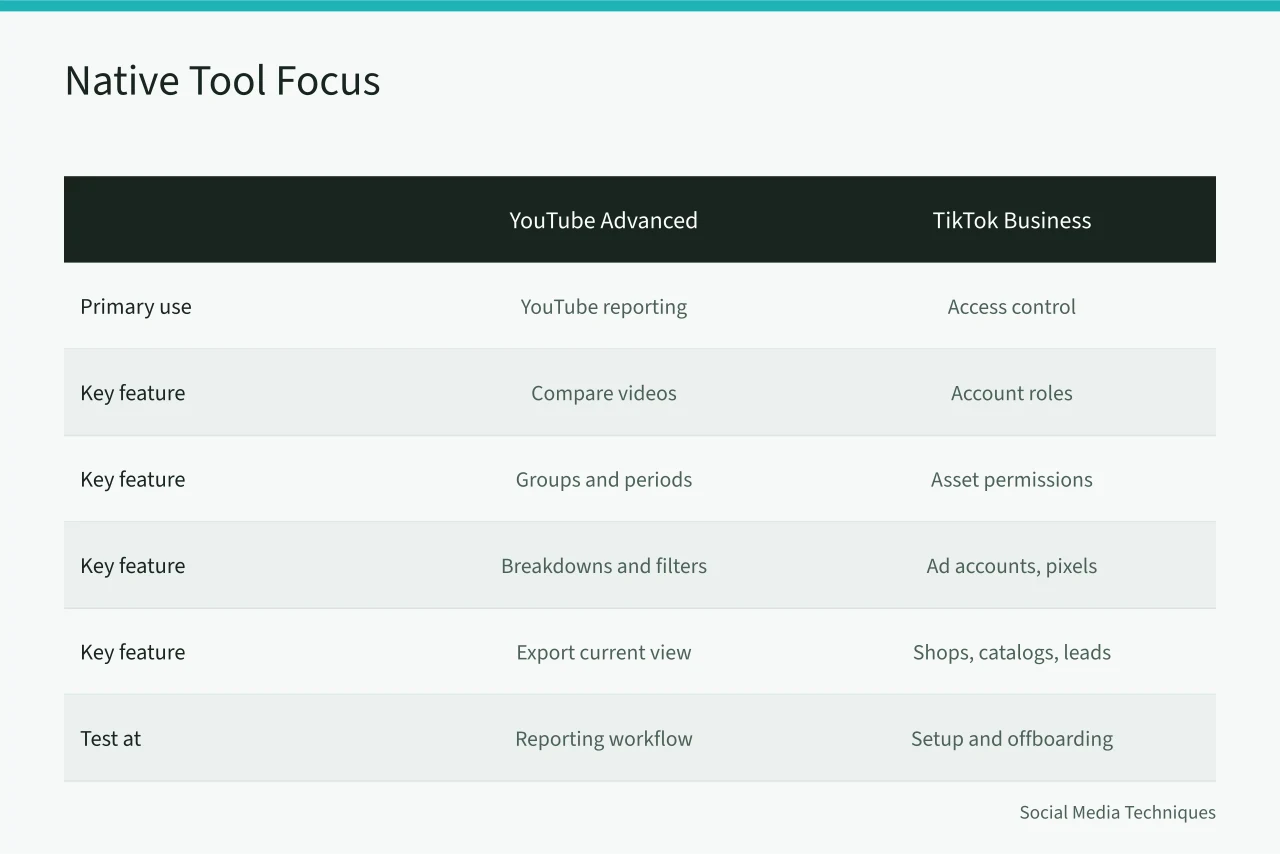
TikTok's current page on account and asset permissions distinguishes account-level roles from access to individual assets. Examples include ad accounts, TikTok accounts, shops, and pixels. Other assets include catalogs, audiences, and leads. That distinction should be tested during setup and offboarding.
1. Name the workflow and the decision
Start with the decision the tool must improve. Teams that need multi-brand calendars often compare Sprout Social and Hootsuite. Teams that need low-cost scheduling compare Buffer and Later. Name the owner, data source, and failure case for that workflow before you shop.
2. Start with platform-native analytics and permissions
Advanced Mode fits teams that need deeper analysis of YouTube channel and video performance. It supports report comparisons, filters, groups, and breakdowns. It also handles date changes and exports. Availability and fields can vary, so confirm the live account view before promising a reporting workflow.
TikTok Business Center fits brands or agencies that need to assign people and partners to accounts and assets. Its value is operational control, not a general social strategy. Map each role to the minimum access needed and maintain a backup owner and removal process.
3. Check publishing, calendar, and approval handoffs
Check whether the tool supports the approval chain your team uses. Hootsuite, Sprout Social, Buffer, and Later all publish scheduling and approval features, but plan limits and user seats differ. Ask for a quote with the exact seats and accounts you need.
4. Test listening and customer service coverage
Brandwatch, Meltwater, and Talkwalker usually quote annual contracts. Ask how query volume, seat count, and data retention drive the price. Sprout Social includes social listening alongside publishing and customer service tools on some plans. Test whether the tool can route a customer complaint from a public post to a named owner with an audit trail.
5. Verify data access, exports, and API limits
Check whether the vendor uses official APIs such as the YouTube Data API, TikTok Business API, or Meta Graph API. Rate limits, review requirements, and field access vary by platform. Ask what happens when an API change breaks a report. Test export formats for scheduled posts, reports, and approval records. Also test files, tokens, users, and historical data.
6. Score security, roles, and offboarding
TikTok Business Center separates account-level roles from asset access, as noted above. Use that model to map minimum access for employees, agencies, and contractors.
Okta, Microsoft Entra, and Google Workspace can enforce single sign-on for tools that support SAML. Check whether the tool supports SAML SSO, SCIM, audit logs, and role-based access control. Before signing, test how users, tokens, and data can be removed.
7. Calculate total cost and contract exit
Add license fees, taxes, implementation work, training, and recurring labor. Buffer Essentials near $6 per channel per month and Later Starter near $25 per month suit small teams. Hootsuite Professional near $99 per month and Sprout Social Standard near $249 per seat per month fit larger workflows.
Brandwatch, Meltwater, and Talkwalker usually quote annual contracts. Review contract term, renewal, and shutdown effort.
When another product may help
- Multi-brand calendars with approval evidence
- Cross-platform customer service and escalation
- Listening beyond owned account activity
- Archiving or required evidence retention
- Consolidated reporting with a documented data model
- Agency workspaces with bounded client access
Run a representative tool test
Use one real workflow with non-sensitive sample data. Ask the intended creators, reviewers, analysts, and administrators to complete their part. Measure time, errors, missing permissions, and export quality. Also measure accessibility, support response, and the decisions the tool improves.
A pilot that measures time and errors gives you the first-party baseline you need for realistic benchmarks.
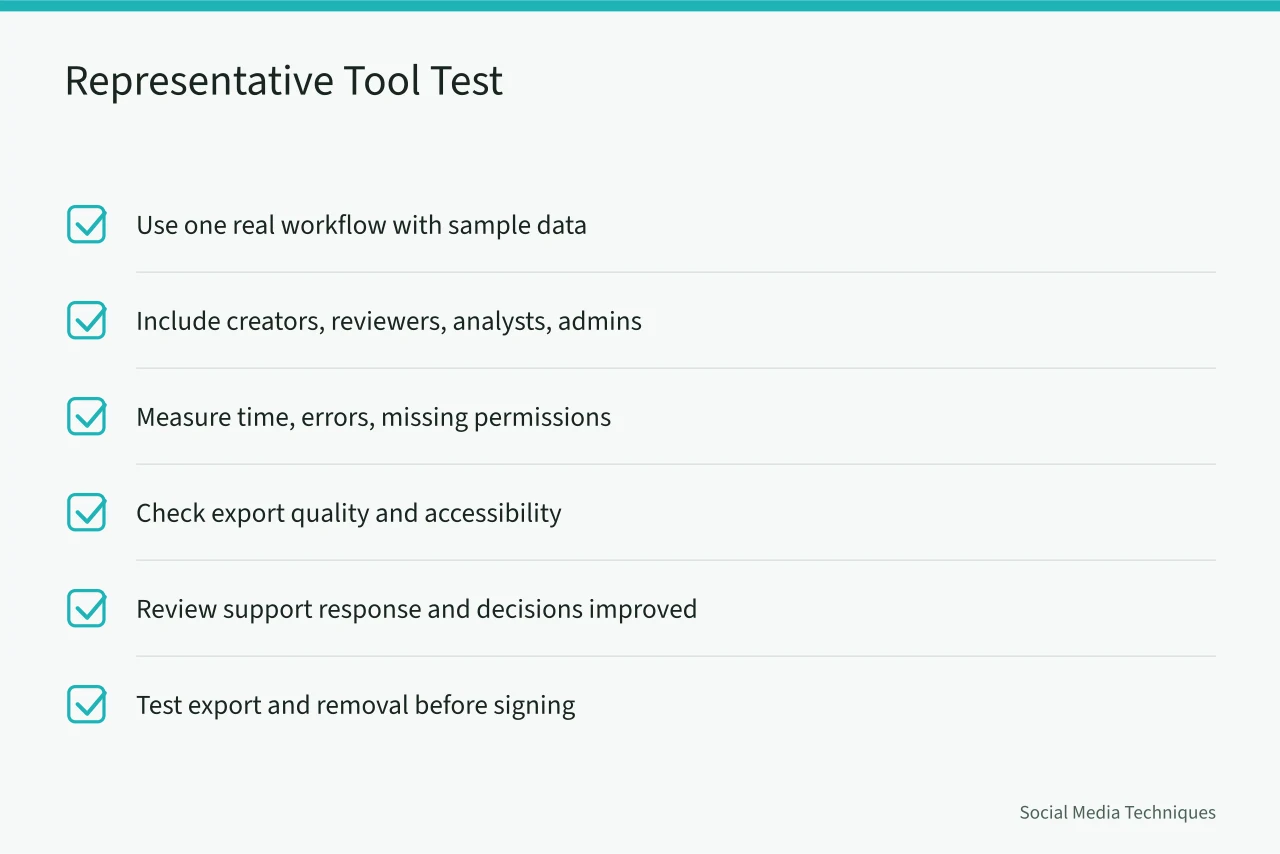
Review authentication, roles, data retention, and integrations. Check contract term, renewal, taxes, implementation work, and training. Before signing, test how scheduled posts, reports, and approval records can be exported or removed. Also test files, tokens, users, and historical data. Recheck current product terms before a 2027 purchase.
Quick comparison
| Tool route | Best use | Main check |
|---|---|---|
| YouTube Advanced Mode | Detailed YouTube analysis and export | Reports, filters, groups, availability |
| TikTok Business Center | Account and asset access control | Roles, assets, partners, removal |
| Hootsuite | Publishing, scheduling, and approval workflows | Plan seats, accounts, price |
| Sprout Social | Publishing, listening, and customer service | Per-seat cost, listening coverage |
| Buffer | Low-cost scheduling for small teams | Per-channel price, user limits |
| Later | Visual planning and scheduling | Plan limits, social networks |
| Brandwatch | Social listening and consumer research | Annual contract, query volume |
| Meltwater | Media monitoring and social listening | Annual contract, data coverage |
| Talkwalker | Social listening and analytics | Annual contract, query volume |
| Third-party platform | A proven cross-platform workflow gap | Security, data model, cost, exit |
Test the operating burden
The GOV.UK technology selection guidance recommends adaptable choices, data control, security review, and ownership-cost analysis. Use those public-service questions when assessing social media strategy tools; they are not product endorsements.
The GOV.UK open standards guidance links open standards with interoperability and reduced supplier dependence. Test whether social media strategy tools data and definitions can move, while keeping the page's UK public-service context clear.
Give each tool the same source sample, user roles, required output, failure case, and export task. Measure setup time, recurring labor, specialist help, correction work, and shutdown effort.
Credit a feature only when an intended user completes the task safely. Save the tested plan and date because a current product page does not promise the same function or price in 2027.
Common questions
What is the best social media strategy tool?
The best tool solves a defined workflow problem for the intended users, data, security controls, budget, and decision.
Should a team start with native analytics?
Yes. Native documentation is the first source for platform-specific permissions, fields, definitions, and reporting limits.
How should social media tools be compared?
Use representative work and score permissions, coverage, accuracy, and export. Also score accessibility, security, support, total cost, and offboarding.